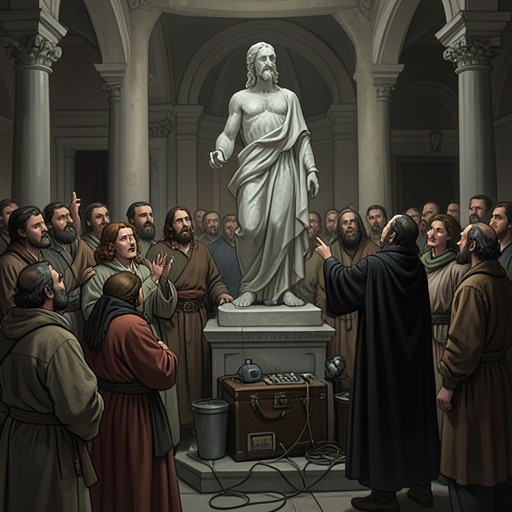
Esmeralda is tortured and forced to confess
The Hunchback of Notre DameEsmeralda is tortured and forced to confess in a judicial proceeding that turns physical coercion into apparent legal proof. Taken into a closed chamber and subjected to the boot, she gives the answers demanded of her, including an admission to murdering Phoebus de Châteaupers. The confession is followed by a death sentence, exposing the gulf between the court’s claim to have established the truth and the circumstances in which its evidence was obtained.
Judicial Setting and Jurisdiction
The scene belongs to a city whose authority was divided among overlapping jurisdictions. In fifteenth-century Paris, the City on the island, the University on the left bank, and the Town on the right bank each had its own institutions and privileges. The island belonged to the bishop, the right bank to the provost of the merchants, and the left bank to the Rector, while the provost of Paris exercised royal authority over the whole. The ecclesiastical court involved in Esmeralda’s case operates within this plural legal order rather than within a single, unified system.
That system could distribute investigation, trial, and punishment across different authorities and places. Offences committed by scholars on the left bank, for example, were tried on the island and punished on the right bank, though the University’s privileges could alter the result. The account also describes sanctuary as a protection recognized in medieval cities: within an asylum, a fugitive was considered safe, but leaving it exposed the person again to arrest and punishment. These arrangements provide a broader context for the court’s power over Esmeralda, while the torture scene itself focuses on the ecclesiastical officials’ control of her interrogation and confession.
The Question Chamber
Police bring Esmeralda, still surrounded by an escort, into a gloomy, windowless chamber on the ground floor of a great tower. Its only entrance is low and secured by a massive iron door. A furnace built into the wall supplies the principal light; around the room are instruments whose purpose she does not understand. At its centre stands a leather bed prepared for the procedure. The chamber’s ordinary name, the Question Chamber, makes the practice sound administrative, but its furnishings reveal the threat that governs what follows.
Esmeralda remains standing at first, frightened by the bed and by the implements around her. At Jacques Charmolue’s signal, two assistants seat her. A physician is present, as are the assistants and Pierrat, who operates the device. Charmolue pauses before choosing how to proceed, then orders the boot. The procedure is not presented as an attempt to test an already established account through impartial questioning: the apparatus is applied to an accused woman, and the officials seek a confession from her under its pressure.
A Confession Produced by Coercion
When the device is operated, Esmeralda cries out. Charmolue immediately stops the procedure to ask whether she will confess. She answers that she will admit everything and begs for mercy. Her capitulation follows the first application of the torture, not a gradual presentation of corroborating evidence. The narrator emphasizes the contrast between the young woman’s formerly pleasant life and her inability to withstand the pain. Her submission is therefore a consequence of the procedure, not reliable proof that the charges are true.
The questioning turns that submission into a catalogue of alleged crimes. Esmeralda agrees that she had dealings with the devil in the form of a goat familiar, and she also assents to the charge that, with demonic aid and the supposed phantom known as the surly monk, she murdered Phoebus de Châteaupers on the night of March 29. Her large, fixed gaze and mechanical response register how completely the interrogation has broken her resistance. The court obtains the words it requires, but the conditions of their production make the confession an indictment of the process as much as an admission by the accused.
Sentence and Institutional Self-Justification
After recording the confession, Charmolue orders the prisoner released from the apparatus and returned to court. The officials present her suffering as compatible with gentleness: the procurator examines her and assures his associates that the harm is not serious, then describes the outcome as justice finally enlightened. This self-congratulation sits uneasily beside the sequence the scene has shown: the accusation is pressed through torture, Esmeralda yields after the first application, and her answers are then entered into the record as a confession.
The judges vote without leaving the room and without giving reasons. The sentence is read aloud: Esmeralda is to be taken at noon in a tumbrel, barefoot and in her shift, with a rope around her neck, to the grand portal of Notre-Dame Cathedral to make a public apology with a two-pound wax torch. She is then to be taken to Place de Grève and hanged; her goat is also condemned, and the sentence imposes a payment of three gold lions to the ecclesiastical court. Esmeralda hears the ruling in a state of shock and is carried away. The torture has thus moved her from accusation to a formal death sentence without resolving the central question of guilt.
Significance
The episode joins the machinery of law to the machinery of punishment. The chamber’s ordered procedure, the clerk’s record, the judges’ vote, and the sentence all give the outcome an official form; none can erase the coercion that produced the confession on which it rests. The court treats compelled assent as confirmation, while its claim of humane treatment depends on minimizing the suffering it has just used to obtain that assent.
Set against the wider account of Paris’s divided authorities and the recognized right of asylum, the scene also shows that legal protection and legal force coexist uneasily. A sanctuary could shield a fugitive within its bounds, but medieval justice still encompassed confinement, interrogation, and execution. Here, the institutional process does not merely pronounce a penalty: it manufactures the confession that makes the penalty appear deserved. The reader is left with a formal judgment whose certainty is contradicted by the scene’s plain account of how Esmeralda was made to give it.